
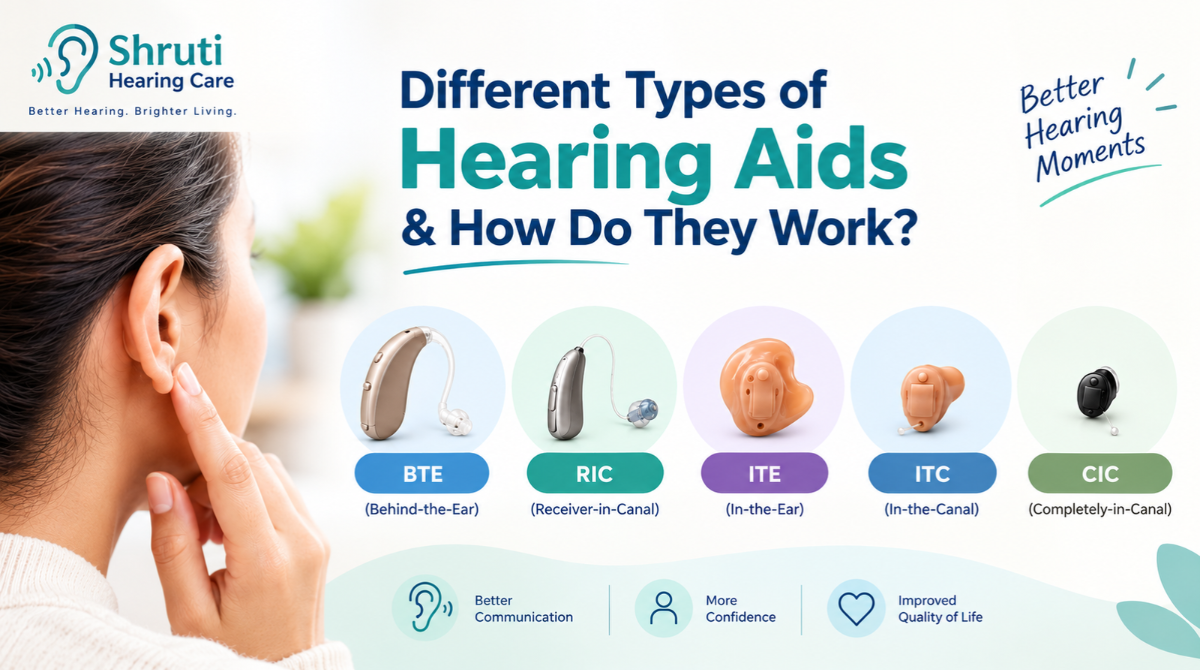
Different Types of Hearing Aids & How Do They Work?
Hear Better, Live Better: A Simple Guide to Choosing the Right Hearing Aid
Have you had trouble hearing in noisy places or have had to ask people to repeat themselves? If you do have hearing problems, then with the right kind of hearing aid, you will be able to hear again!
At Shruti Hearing Care, learning about the various kinds of hearing aids available will help you take that informed step forward towards better hearing. Let’s learn about the various hearing aids and their functionality!
How Do Hearing Aids Work?
The majority of contemporary hearing aids consist of three components: microphone to capture sounds, digital processor to modify and amplify sounds and speaker to output the modified sounds. Some hearing aids even allow for reduction of noise.
Nevertheless, hearing aids do not provide normal hearing and their success is dependent upon the extent of the hearing impairment and hearing aid model chosen by a person.
5 Different Types of Hearing Aids
1. Behind-the-Ear (BTE) Hearing Aids
BTE hearing aids are one of the widely used hearing devices in the world. They can be placed comfortably behind the outer ear and transmit sounds via a tubing system connected to an earmold or ear tip. Such devices collect sounds using a microphone and then process them electronically and amplify them based on the user’s hearing loss.
BTE hearing aids come in various designs and power levels. They are convenient to wear and maintain, which makes them a good choice for a lot of individuals, including elderly people.
Recommended for: Individuals suffering from hearing loss at any level of severity.
2. Receiver-in-Canal (RIC) Hearing Aids
The Receiver-In-Canal (RIC) type of hearing aid consists of a small piece that rests behind the ear and another piece which acts as a receiver and is inserted into the ear canal by connecting both with a very thin wire.
Such types of hearing aids have the potential to deliver high-quality sound and can be equipped with many advanced features such as Bluetooth connection and noise reduction systems.
Suitable for: Individuals who are looking for a light, discreet and feature-packed hearing aid.
3. In-the-Ear (ITE) Hearing Aids
In-the-Ear (ITE) hearing aids are customized to fit the external part of the ear. The electronics are all contained in one piece which makes it easy to remove and put back in place. The size also provides space for controlling switches and other optional features.
There are different sizes of ITE hearing aids which make them adaptable to different levels of hearing problems. This being the case, it becomes necessary to clean and maintain them from any form of ear wax and moisture.
Best for: People who want a customized hearing aid and are comfortable handling an in-the-ear device which is not as small as the in-canal hearing aids.
4. In-the-Canal (ITC) Hearing Aids
The In-the-Canal (ITC) hearing aid is specially designed to fit within the ear canal. It is more inconspicuous than the ITE hearing aid and, at the same time, offers a more comfortable fit.
Various types of ITC hearing aids come equipped with features like volume controls, directional microphones, among others. The downside of the ITC hearing aid is that its small size makes it difficult to operate for people with poor manual finger movement ability.
Recommended for: People who are looking for a relatively discreet hearing aid.
5. Completely-in-Canal (CIC) Hearing Aids
CIC hearing aids are designed to fit deeply into the ear canal and, thus, are among the most discreet traditional hearing aids. CIC hearing aids are custom-fitted to the ear of the wearer and are ideal for people who seek a discreet option for their hearing problem.
The small size of CIC hearing aids makes it challenging for the users to put them on, take them off, and clean them. Also, they come with smaller batteries and fewer physical controls compared to other types. Not all people are suitable for CIC hearing aids.
Ideal for: People who desire discretion in their hearing aids.
How to Choose the Right Hearing Aid
Selection of the appropriate hearing aid is based on your level of hearing impairment, lifestyle, comfort, financial constraints, and other individual factors. Other important considerations may include things such as Bluetooth capability, rechargeable batteries, and noise management.
Professional hearing evaluation done by a certified hearing care specialist can be used to determine your requirements and appropriate equipment.
Conclusion
Hearing aids have the potential to make day-to-day conversations much easier to hear. There are many types of hearing aids, including those worn behind the ear and almost invisible canal aids.
Start improving your hearing today with Shruti Hearing Care! Meet with a hearing care specialist and discover what is best for your situation.