
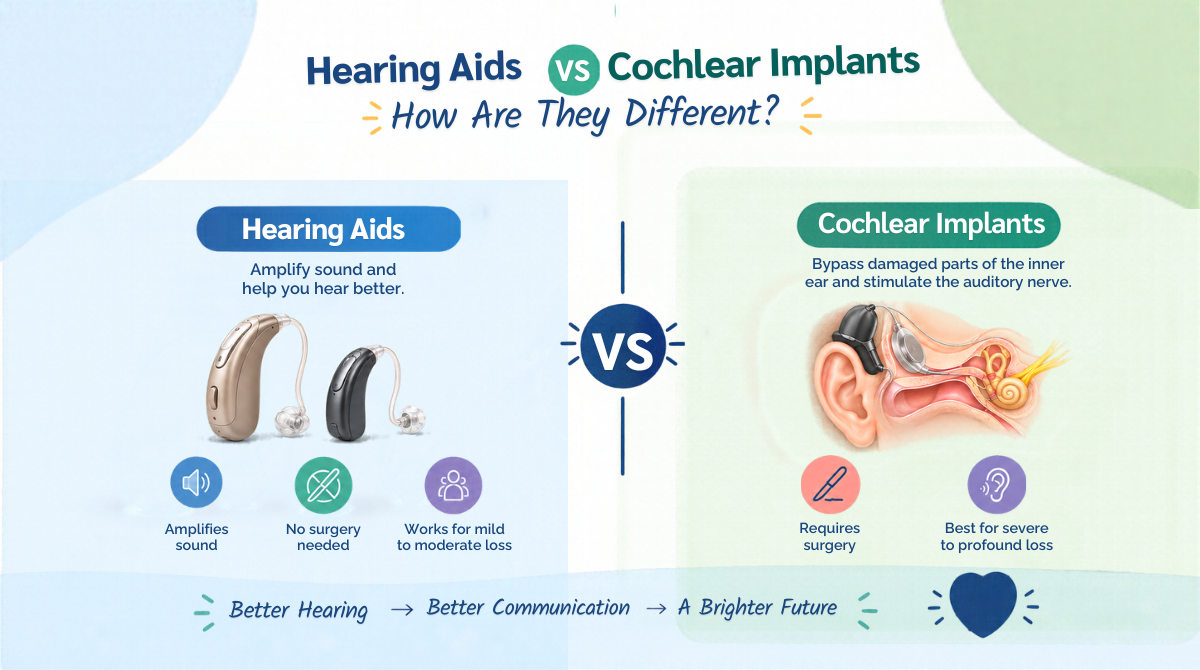
Hearing Aids vs Cochlear Implants: How Are They Different?
Trouble hearing in conversations? Advanced hearing devices can help improve communication and allow an individual to communicate with loved ones easily. These include the hearing aids and cochlear implants. While both assist people with hearing loss, they have differences in how they function and when used best.
Let’s understand the difference in simple words!
What Are Hearing Aids?
A hearing aid is a tiny electronic device used to amplify sound, enabling people with hearing problems to hear better. The hearing aid is normally worn behind or in the ear.
The device captures sound through a microphone and sends it back to the ear after processing.
Advantages of hearing aids:
- It makes sounds easy to hear.
- They come in various sizes and types.
- It works well for people suffering from hearing loss to varying degrees.
- It does not involve any surgery.
The hearing aid can be prescribed to people whose inner ear processes amplified sounds efficiently.
What Are Cochlear Implants?
Cochlear implants are electronic medical devices that help individuals suffering from profound hearing impairment and have little or no improvement from hearing aids.
They work differently from hearing aids because they do not amplify sounds but rather go around the broken parts of the inner ear and stimulate the auditory nerve using electricity that is interpreted by the brain as sound.
It consists of two parts – an external component that the individual wears behind the ear and an internal component that is surgically implanted under the skin.
Advantages of cochlear implants:
- Helps in accessing sound where hearing aids fail to give adequate assistance.
- Auditory nerve helps in speech perception of appropriate individuals.
- Aids communication and day-to-day tasks through rehabilitation.
Results of the implantation process vary depending on each patient and require some listening training and rehabilitation.
Hearing Aids vs Cochlear Implants: Key Differences
Here is a quick comparison to help you understand the two options.
Feature | ||
Mode of operation | Increase sound | Transmission of signals to the auditory nerve |
Best used for | Various kinds of mild to moderate hearing impairments | Severe to profound hearing loss, selected cases |
Surgery needed | Not | Yes |
Primary function | Make sounds more audible and distinct | Making sound available for hearing when amplification is not enough |
Aftercare | Auditory testing, fitting and adjustment | Programming, check-ups, and hearing rehabilitation |
Which Option Is Right for You?
It all depends on the results of your hearing test, the nature of your hearing loss, speech recognition and other individual factors.
For most individuals, hearing aids will be the first thing to try. If it helps only a little bit, then an audiologist and ENT physician will determine if you can use a cochlear implant.
Important note: You should never buy any hearing aid solely based on cost or personal experience.
Conclusion
The use of hearing aids and cochlear implants varies, but they can aid individuals who have hearing problems.
If there are any symptoms that show a hearing problem in you or anyone around you, do not delay in seeking proper advice. Getting an early diagnosis is a good way to determine what would be best for you.
Start working towards better hearing now! Make an appointment with an expert at Shruti Hearing Care to learn more about your hearing requirements.